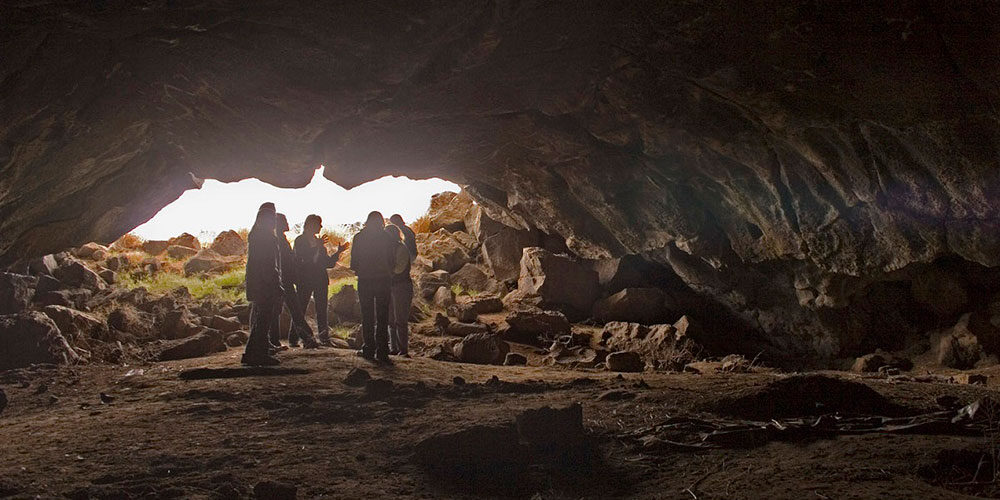
“Wilson Butte Cave” by the Bureau of Land Managment, Wiki Commons
Exploring the Ancient Mysteries of Wilson Butte Cave in Idaho
Tucked away on the expansive Snake River Plain in Jerome County, Idaho, lies a hidden gem of immense historical significance – Wilson Butte Cave. This remarkable site, located northeast of Twin Falls and southeast of Shoshone, is not just a geographic marvel but a crucial piece in the puzzle of human history in North America.
Historical Significance & Archaeological Findings
Listed on the National Register of Historic Places, Wilson Butte Cave is maintained with great care by the Bureau of Land Management (BLM). Its unique appearance is striking – a round bubble rising abruptly from a flat, wide bed of ancient basalt lava. This feature is an inflationary or uplift cave, a rare formation that intrigues both geologists and archaeologists alike.
Evidence of Ancient Inhabitants
The history of Wilson Butte Cave is deeply intertwined with the earliest known human activities in the region. Archaeologists, though uncertain about precise timelines prior to 10,000 years ago, have found compelling evidence that native peoples inhabited this cave at least that long ago. These findings are not just significant for the history of the Snake River Plain but are among the oldest evidences of human presence in North America. The artifacts discovered here offer a tantalizing glimpse into the lives of these ancient inhabitants, suggesting that the cave served as a strategic base for hunting bison.
Cultural Connections & Environment
The cave’s connections extend to notable cultures, including the Fremont culture and the Shoshone people, who occupied the area after the Fremont. This continuity of habitation provides a rich tapestry of human history, offering insights into the evolving lifestyles and traditions of these groups. Remarkably, the surrounding vegetation has remained largely unchanged over millennia, a silent witness to a landscape that once supported camels and giant ground sloths.
Modern Discovery & Excavations
The undisturbed nature of the deposits in Wilson Butte Cave is itself a story of modern discovery. Until amateur explorers stumbled upon it in 1958, the cave’s secrets lay hidden. The subsequent excavations, particularly those led by Ruth Gruhn in 1959–1960 and 1988–1989, have been pivotal in unearthing its history. Gruhn’s work dates the site’s earliest occupation to an astonishing 14,000–15,000 years ago.
Geological Aspects of Wilson Butte Cave
Geologically, the cave is as fascinating as its archaeological treasures. Formed within a lava tube developed in a pressure ridge, it lies amidst dark gray to black fine-grained basalt. The origins of this lava, more than 15,000 years old, trace back to Wilson’s Butte, situated about half a mile southeast of the cave. Intriguingly, radiocarbon dating of a camel bone, marked with tool indications of human work, from within a lava tube cave nearby, supports this timeline.
Adventurous Things to Do in Idaho: Wilson Butte Cave
Today, Wilson Butte Cave is more than a scientific site; it’s a destination for adventure and discovery. While relatively unknown and modest in size, the cave’s historical depth is immense. Listed on the National Register of Historic Places, it beckons adventurers and history enthusiasts alike to step into a world where ancient humans once roamed. Its presence on the vast Snake River Plain is a testament to the rich, layered history that Idaho harbors, waiting to be explored and appreciated. Whether you’re a seasoned archaeologist, a geology enthusiast, or simply a curious explorer, visiting Wilson Butte Cave is an adventurous thing to do in Idaho that promises a unique journey through time.
Quick Facts About Wilson Butte Cave
- Wilson Butte Cave is a site of immense historical importance, listed on the National Register of Historic Places and located on the expansive Snake River Plain in Jerome County, Idaho.
- The cave is known for its striking appearance, resembling a round bubble emerging from a flat bed of ancient basalt lava, an example of an inflationary or uplift cave.
- Archaeological evidence suggests that Wilson Butte Cave was inhabited by native peoples at least 10,000 years ago, making it one of the oldest sites of human presence in North America.
- The cave has ties to significant cultures, including the Fremont culture and the Shoshone people, offering insights into the lifestyles and traditions of these groups over millennia.
- Notable excavations led by Ruth Gruhn in 1959–1960 and 1988–1989 revealed that the site’s earliest occupation dates back to an astonishing 14,000–15,000 years ago.
- Wilson Butte Cave is formed within a lava tube developed in a pressure ridge, with findings like a radiocarbon-dated camel bone showing tool markings, indicating human activity over 15,000 years ago.
Idaho’s Mammoth Cave

Planning a trip through Idaho? Idaho’s Mammoth Cave is a stop worth adding along the way. This unique destination lets you explore a naturally formed underground lava tube at your own pace, giving you a chance to experience something completely different from Idaho’s rivers, parks, and trails.
Along with the cave, you’ll also find two privately owned natural history museums on-site, the Shoshone Bird Museum and the Richard Arthur Olsen Museum. Together, they feature a wide range of exhibits that have earned the nickname “The Smithsonian of the Desert,” making it a memorable stop for visitors of all ages. Located eight miles north of Shoshone along Highway 75, the cave is open seasonally from May through October, from 10 a.m. to 6 p.m., with last tours at 5 p.m., seven days a week, including major holidays. For more information, visit idahosmammothcave.com or call (208) 329-5382.
For a complete statewide travel guide, see our complete guide to things to do in Idaho.