Twin Falls, Idaho, sits at the center of one of the most activity-rich regions in the American West. Within 30 minutes of downtown, you’ll find Shoshone Falls, the Snake River Canyon, Perrine Coulee Falls, and Dierkes Lake. Within 45 minutes, Idaho’s Mammoth Cave offers one of the largest volcanic lava-tube systems open to the public in the United States. Within an hour, Blue Heart Springs, Malad Gorge, Hagerman Fossil Beds, and Nat-Soo-Pah Hot Springs round out one of the most concentrated collections of natural attractions in southern Idaho. This guide covers the best things to do near Twin Falls, Idaho, for every type of visitor.
Key Takeaways
- Idaho’s Mammoth Cave is about 40 to 45 minutes north of Twin Falls and is one of the largest volcanic lava tubes open to the public in the United States, with two natural history museums included in one admission
- Shoshone Falls, often called the Niagara of the West, drops 212 feet into the Snake River Canyon just 10 minutes from downtown Twin Falls
- The Perrine Bridge may be the only place in the United States where BASE jumping is legal year-round without a permit
- Blue Heart Springs near Hagerman is only accessible by kayak and features water so blue that most visitors say it doesn’t look real
- The Twin Falls area has more natural attractions within a short drive than most visitors ever expect to find

Twin Falls and the surrounding Magic Valley pack more natural surprises into a short drive than most regions in the American West. Within 30 minutes of downtown, you’ll find Shoshone Falls, the Snake River Canyon, and canyon lakes where locals have been swimming for generations. Within 45 minutes, there’s a self-guided volcanic lava tube with two natural history museums included. Within an hour, blue springs, slot canyons, geothermal pools, and ancient petroglyphs round out one of the most varied road trip corridors in southern Idaho.
This guide covers the best things to do near Twin Falls, Idaho, organized by drive time so you can plan your trip without backtracking. For a broader look at what the rest of the state has to offer, our complete guide to things to do in Idaho is a good place to start.
Within 30 Minutes of Twin Falls: The Canyon, the Falls, and the Rim
Everything in this section is within a short drive of downtown Twin Falls. Most visitors only find half of it. The other half is worth knowing about.
Shoshone Falls — 10 Minutes East

Most people have heard of Niagara Falls. Fewer people outside Idaho know that Shoshone Falls is 45 feet taller.
Shoshone Falls drops 212 feet over a horseshoe-shaped basalt cliff nearly 900 feet wide, about three miles northeast of Twin Falls along the Snake River Canyon. It’s one of the most powerful displays of moving water in the American West and one of Idaho’s most visited natural landmarks.
Spring is the best time to visit. Snowmelt pushes the Snake River to its seasonal peak, and the falls run loud and full. By late summer, water is diverted upstream for irrigation, and the flow drops significantly. Check current flow rates on the City of Twin Falls website before visiting in summer or fall.
The park has multiple viewing platforms, a paved trail connecting them, picnic areas, a boat ramp, and access to Dierkes Lake. On sunny days, the mist from the falls creates rainbows over the canyon.
What to know: 4155 Shoshone Falls Grade Road, Twin Falls. Day-use fee $5 per vehicle, March through fall. Season passes are available for $30. Open dawn to dusk.
Snake River Canyon — 5 Minutes

The Snake River Canyon is practically in your backyard if you’re staying in Twin Falls. The canyon stretches more than 50 miles through the Magic Valley and reaches depths of up to 500 feet, with dark, layered basalt walls carved by the Snake River over millions of years.
The Snake River Canyon is best explored from multiple vantage points. The Twin Falls Visitor Center on the south side of the Perrine Bridge has parking, trail access, and canyon overlooks. The paved Canyon Rim Trail runs along the south rim from near the bridge east toward Shoshone Falls. Centennial Waterfront Park at the canyon floor offers river access, kayaking, paddleboarding, and picnic areas.
To the east of the bridge along the south rim, the dirt ramp used by Evel Knievel when he attempted to jump the canyon on his steam-powered Skycycle X-2 in September 1974 is still visible. It’s one of those roadside landmarks that feels bigger in person than you’d expect.
What to know: The Twin Falls Visitor Center is free. The Canyon Rim Trail is paved and accessible. Centennial Waterfront Park is at the bottom of Canyon Springs Road. No entrance fee for the canyon.
Perrine Bridge — 5 Minutes

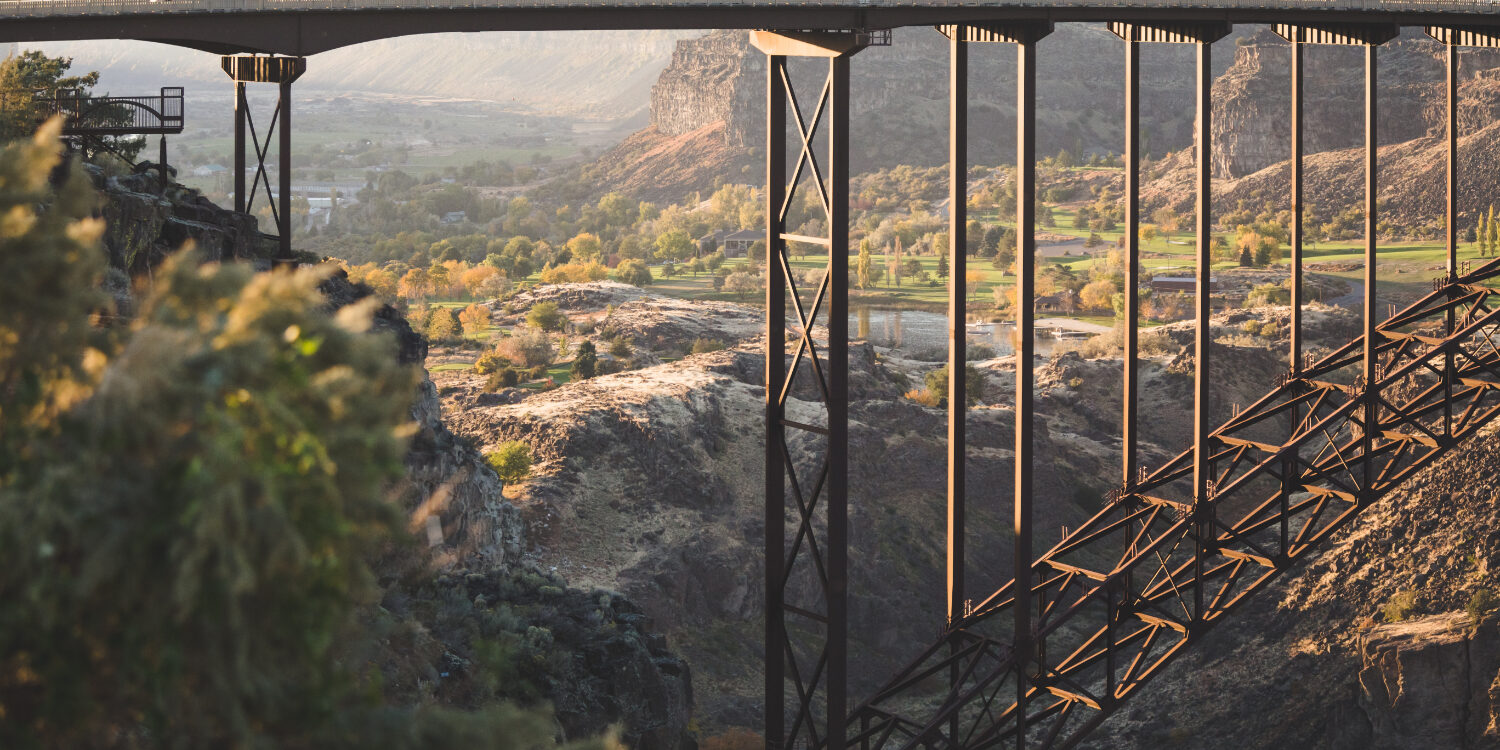
The Perrine Bridge spans 1,500 feet across the Snake River Canyon and stands 486 feet above the river, making it the eighth-highest bridge in the United States. Pedestrian walkways run along both sides, offering straight-down views into the canyon and upstream toward Shoshone Falls.
The Perrine Bridge may be the only man-made structure in the United States where BASE jumping is legal year-round without a permit. On most weekends, you can watch jumpers leap from the east side of the span and follow their parachute descent down to the canyon floor. The first recorded jumps from the bridge happened in 1987. Even if jumping isn’t your thing, watching someone else do it from the pedestrian walkway is genuinely memorable.
What to know: The bridge carries U.S. Highway 93 over the canyon on the north edge of Twin Falls. Free to walk. Pedestrian access from both sides. Best jumping activity on weekend mornings in summer.
Perrine Coulee Falls — 10 Minutes

Most visitors to Twin Falls drive right past Perrine Coulee Falls without realizing it’s there. The parking area sits at the first switchback on Canyon Springs Road as it descends into the canyon, and the falls drop nearly 200 feet off the canyon rim just steps from the road.
A short trail leads behind the falls. Standing behind nearly 200 feet of falling water and looking out through the curtain into the Snake River Canyon is one of the more memorable vantage points in southern Idaho. The falls run year-round, fed by irrigation sources and Perrine Coulee Creek.
What to know: Access via Canyon Springs Road off Blue Lakes Boulevard North in Twin Falls. Park at the first switchback on the descent. Short walk to the falls and behind them. Plan to get wet. No fee.
Pillar Falls — 15 Minutes

Pillar Falls is one of those Twin Falls area stops that most visitors miss entirely. A series of basalt pillars and cascades sit on the Snake River east of Shoshone Falls. Pillar Falls is accessible by a short hike from Shoshone Falls Park or by kayak from Centennial Waterfront Park. The basalt formations are dramatic up close, and the canyon setting puts it in a completely different category from the more visited overlooks nearby.
What to know: Access via the trail east from Shoshone Falls Park or by kayak from Centennial Waterfront Park. The $5 Shoshone Falls day-use fee covers trail access. Sturdy footwear recommended.
Dierkes Lake and the Hidden Lakes — 10 Minutes

“Dierkes Lake” by stephenhanafin is licensed under CC BY-SA 2.0.
Most visitors pay the Shoshone Falls entrance fee, walk to the overlook, and leave. Locals follow the trail east and end up somewhere most out-of-state visitors never find.
Dierkes Lake sits within the Snake River Canyon and features a designated swimming area from approximately June through late August, a dock, and a floating raft. It’s a genuine swimming destination hidden inside a desert canyon.
Continue east on the trail, and the canyon opens into a series of Hidden Lakes ringed by basalt cliffs. Heights range from 5 feet to over 80 feet. Cliff jumping here has been a Twin Falls tradition for generations. The underwater visibility is only about 5 feet, there are rock ledges at the base of some cliffs, and there are no lifeguards at the Hidden Lakes. Always scout the landing zone from the water before jumping from above. Start low. Never dive headfirst. Never jump alone.
What to know: Access via the Shoshone Falls parking area. The $5 day-use fee covers access to Dierkes Lake. No lifeguards, no designated jumping area, and no signage at the Hidden Lakes.
Nat-Soo-Pah Hot Springs, Near Hollister — 20 Minutes South

Most Idaho hot springs are about quiet soaking in nature. Nat-Soo-Pah is about something else entirely.
Located about 16 miles south of Twin Falls near Hollister, Nat-Soo-Pah is a family-owned geothermal resort. The site has been used for bathing since the 1920s. The name means “Magic Mineral Water” in Shoshone, a nod to the Native Americans who used the spring long before the resort existed.
The centerpiece is a 125-foot by 50-foot swimming pool, naturally heated to 92 to 99 degrees by thermal water bubbling up from the high desert. The pool has a 90-foot water slide and two diving boards. There’s also a hot soak pool at 104 to 106 degrees and a jetted tub at 100 degrees. There’s a snack bar, an arcade room with a pool table and jukebox, and a campground with 75 sites, including 29 with full RV hookups.
What to know: Located off U.S. Highway 93 near Hollister, about 16 miles south of Twin Falls. Open approximately May 1 through Labor Day. Admission is $10 for ages 6 and up and $5 for ages 1 to 5. Check natsoopah.com or call 208-655-4337 for current rates, hours, and payment methods before visiting. Swimsuits required. Lifeguards on duty. Pets are welcome in the campground but not in the pool area.
Balanced Rock — 30 Minutes West

Balanced Rock is one of those places that’s hard to believe until you’re standing in front of it. A 48-foot column of volcanic rhyolite balances on a pedestal just 3 feet by 17 inches near Castleford. The rock weighs approximately 40 tons and has been balanced on that narrow base for thousands of years.
A short paved path circles the formation, and a small park surrounds it. It’s a quick stop but a genuinely striking one, especially combined with a drive through the Salmon Falls Creek Canyon area nearby.
What to know: Located at Balanced Rock County Park near Castleford, Idaho, about 30 minutes west of Twin Falls off Highway 30. No entrance fee. Short paved trail around the formation. Open year-round.
Within 40 to 45 Minutes of Twin Falls: The Cave, the Canyon, and the Slot
These destinations are just far enough from Twin Falls to feel like a real excursion but close enough to combine easily with a morning or afternoon back in the city.
Idaho’s Mammoth Cave, Shoshone — 40 to 45 Minutes North

If there’s one stop near Twin Falls that consistently surprises people, it’s this one.
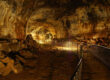
Idaho’s Mammoth Cave sits eight miles north of Shoshone on Highway 75, at the end of a dusty mile of gravel road off the highway. It’s one of the largest volcanic lava tubes open to the public in the United States and the largest volcanic cave open to the public in southern Idaho. The tour is completely self-guided, which means you move at your own pace with no tour group and no set schedule. Lanterns are provided at the entrance. Bring a flashlight if you have one.
You’ll walk a quarter mile in and a quarter mile out through a preserved volcanic passage. The ceiling is higher than you’d expect. The walls stretch wider than the entrance suggests. Parts of the cave glow silver from cyanobacteria, ancient living organisms dating back nearly four billion years that exist on the walls of only a handful of caves in the world. Mineral deposits streak the walls in golds, oranges, and reds. The cave stays at 42 degrees year-round, so bring a light jacket.
The Museums

The property includes two natural history museums: the Shoshone Bird Museum of Natural History and the Richard Arthur Olsen Museum of Natural History. Together, they’ve earned the nickname the Smithsonian of the Desert. One admission covers all three attractions. Most visitors plan 30 minutes and end up staying two hours.
The Cold War History
During the 1960s, the U.S. government designated the cave as a nuclear fallout shelter capable of housing 8,000 people. The original radiation warning sign is still posted at the entrance today.
A quick note: Idaho’s Mammoth Cave is sometimes confused with the nearby Shoshone Ice Caves, which are a completely separate and independently owned attraction currently closed for the 2026 season. Idaho’s Mammoth Cave is open and welcoming visitors.
What to know: Open May 1 through Labor Day daily from 10 a.m. to 6 p.m., with last entry at 5 p.m. After Labor Day, weekends only through September 29. Adults $15, ages 12 and under $9, ages 5 and under free. Not handicap accessible. Dogs aren’t allowed. Reservations aren’t required. Address: 251 W Thorn Creek Road, Shoshone, Idaho. From Twin Falls, take U.S. 93 north to Highway 75 north toward Shoshone.
Black Magic Canyon, Shoshone — 45 Minutes North

“Black Magic Canyon Slot Canyon Shoshone Idaho” by amanderson2 is licensed under CC BY 2.0.
Most people in Twin Falls have heard of Black Magic Canyon. Not many have actually been there. That’s what makes it worth knowing about.
Black Magic Canyon is a sculpted basalt slot canyon carved by the Big Wood River north of Shoshone over the past 10,000 years. The 800,000-year-old lava flows have been shaped into narrow passages, towering dark walls, and formations that look like they belong in Utah’s Antelope Canyon, not the Idaho high desert. The walls close in as you move through the canyon, and the light shifts in ways that make it a favorite for photographers.
Head north of Shoshone on Highway 75 about 5 miles, then turn east onto Road 520. Follow Road 520 east until it curves north. Continue to the end of the road and park at the old dam. Walk down the sandy rocks into the canyon from there.
One critical piece of information before you go: the Big Wood Canal Company controls water flow through this canyon and can release water from the upstream dam at any time. If there is any water flowing in the canyon, do not enter. Flash flooding in the narrows would be fatal. Call the Big Wood Canal Company before visiting to confirm water conditions. The canyon is generally accessible from late July through winter, with fall being the best season.
What to know: Located north of Shoshone off Highway 75. No entrance fee. Call the Big Wood Canal Company before visiting to confirm water conditions. Sturdy footwear required. Watch for rattlesnakes. Best visited late July through fall.
Within 45 to 60 Minutes of Twin Falls: Springs, Gorges, and Fossil Beds
A short drive west of Twin Falls opens up a stretch of the Snake River Plain that most visitors never reach. These are the stops worth planning around.
Kayaking to Blue Heart Springs, Hagerman — 45 Minutes West

About 45 minutes west of Twin Falls near Hagerman, the Snake River runs a milky shade of green. Paddle about 1.5 miles downriver from the launch point, and the color of the water starts to change. By the time you round the bend into the sheltered alcove, the river has turned sapphire blue so vivid that people say they couldn’t believe it was real until they were floating in it.
Blue Heart Springs is one of North America’s 13 largest freshwater springs, fed by the Snake River Plain Aquifer. Water takes 100 to 150 years to filter through ancient basalt rock before surfacing here at a consistent 58 degrees year-round. From above, the spring forms a near-perfect heart shape. The springs are only accessible by water. No road, no trail, no other way in. Swimming is allowed.
Three outfitters serve the area. Banbury Adventures at Banbury Hot Springs near Hagerman rents kayaks and paddleboards Monday through Saturday, April through September. Blue Heart Kayaking in Buhl offers guided and self-guided options. Idaho Boathouse offers free delivery to launch points in the Hagerman area.
What to know: Along the Snake River near Hagerman, about 45 minutes west of Twin Falls. The paddle from Banbury takes 45 minutes to an hour one way with the current. The return trip is upstream and takes longer, so plan for a 3-mile round trip in total. Reserve rentals in advance on summer weekends. Motorized boat engines aren’t permitted within the springs.
Malad Gorge State Park — 30 Minutes West

“The Malad Gorge in Idaho” by thejesse is licensed under CC BY-SA 2.0.
Malad Gorge State Park sits just off Interstate 84 near Hagerman and is one of those places that stops people mid-conversation. The Malad River has carved a canyon through the basalt, reaching depths of 250 feet, with near-vertical walls that drop straight to the river below.
The most dramatic feature is a natural formation called the Devil’s Washbowl, where the Malad River crashes down a series of stair-step falls dropping approximately 60 feet into a circular pool carved into the basalt below. A footbridge spans the gorge and gives visitors a view straight down into the canyon and over the waterfall.
What to know: Part of Thousand Springs State Park, located near Hagerman off Interstate 84 at the Tuttle exit, about 30 minutes west of Twin Falls. Day-use fee $7 per vehicle. Idaho State Parks Passport accepted. Open year-round.
Hagerman Fossil Beds National Monument — 45 Minutes West

“Hagerman Fossil Beds” by Chris Light is licensed under CC BY-SA 4.0.
Hagerman Fossil Beds preserves one of the world’s richest deposits of Pliocene-era fossils along the Snake River Canyon corridor near Hagerman. The site is best known for the Hagerman Horse, an ancestor of the modern horse found here in greater numbers than anywhere else on earth.
The monument spans 4,351 acres along the west bank of the Snake River and includes fossil sites, Oregon Trail history, and scenic canyon overlooks. The visitor center moved to a new location in 2022 and is now located at 17970 US Highway 30, about one mile north of downtown Hagerman. The monument’s trails and scenic overlooks are located approximately 9 miles from the visitor center on Bell Rapids Road.
What to know: Visitor center at 17970 US Highway 30, Hagerman, about 45 minutes west of Twin Falls. No entrance fee. Hours vary by season. Check nps.gov/hafo for current visitor center hours before visiting. Trails and overlooks are open from sunrise to sunset year-round. Call 208-933-4105 for more information.
Day Trips Worth the Drive: 60 to 90 Minutes from Twin Falls
These destinations are far enough from Twin Falls to warrant a dedicated day but close enough to make them practical. Each one delivers something completely different from anything closer to the city.
Bruneau Sand Dunes and Stargazing — About 90 Minutes West

The tallest single-structured sand dune in North America rises 470 feet above the desert floor about 90 miles west of Twin Falls near Bruneau. What makes the Bruneau Sand Dunes unique is that they form near the center of their basin rather than at the edge. Opposing winds from the southeast and northwest keep the sand trapped in place. The dunes have been building for more than 12,000 years.
Sandboards are rented at the Visitor Center for $15 for one or $25 for two. Rentals stop when the temperatures reach 80 degrees or 3 p.m., whichever comes first. Spring and fall mornings work best. Summer sand surface temperatures can exceed 150 degrees.
Two small lakes at the base of the dune are open for swimming and fishing. After dark, Bruneau Dunes became a certified International Dark Sky Park in 2024. The observatory houses two powerful telescopes and runs programs on Friday and Saturday nights from mid-March through mid-October for $5 per person.
What to know: About 90 miles west of Twin Falls off Highway 78 and 51. Day-use entry is $7 per vehicle. Sandboard rentals are $15 for one board or $25 for two. Observatory $5 per person. Call 208-366-7919 for current conditions and observatory schedule.
Bruneau Canyon Overlook — 2 Hours West

“Bruneau River Overlook” by BLMIdaho is licensed under CC BY 2.0.
While you’re in the Bruneau area for the sand dunes, the Bruneau Canyon Overlook is worth adding to the same day. Most people have heard of Hells Canyon. Far fewer people have heard of Bruneau Canyon, which cuts through the high desert of southwestern Idaho and reaches depths of more than 800 feet with near-vertical walls of basalt and rhyolite dropping straight to the river below.
The overlook has guardrails, a vault toilet, paved pathways, and interpretive signs. In late afternoon, the light catches the canyon walls and shifts the basalt from dark grey to amber. The canyon appears with almost no warning, and the views are extraordinary.
What to know: In the town of Bruneau, turn east onto Hot Springs Road at the One Stop gas station on Highway 51. Drive approximately 15.5 miles, then turn right at the signed Bruneau Canyon Overlook junction. Follow the gravel road 3 more miles to the overlook parking area. Passenger cars handle the road fine in dry conditions. No entrance fee. Bring water.
Family Friendly Things to Do Near Twin Falls
The Twin Falls area has strong options for families with children of all ages. Here are two worth planning around.
Idaho’s Mammoth Cave for Families

Idaho’s Mammoth Cave deserves a second mention here because it consistently works well for families with children of all ages. The self-guided tour means you move at your own pace. Kids who would lose interest in a guided tour stay engaged because they’re in control. The museums hold attention in ways that are hard to predict, as fossils, taxidermy, ancient pottery, gemstones, and Cold War history tend to spark more questions than you’d expect. Children 5 and under are admitted free.
What to know: See full details in the 40 to 45 Minutes section above.
Magic Valley Fair and Rodeo — Twin Falls

Image Credit: Seth Lemmons Photography” by Seth Lemmons is licensed under CC BY 2.0.
The Magic Valley Fair and Rodeo is one of the signature summer events in the Twin Falls area. Held annually at the Twin Falls County Fairgrounds, the fair brings carnival rides, live entertainment, livestock shows, and one of the region’s most popular PRCA rodeos together for a week of classic Idaho summer fun. It draws visitors from across the Magic Valley and surrounding counties every year.
What to know: Held annually at the Twin Falls County Fairgrounds. Check the Twin Falls County Fair website for current dates, admission prices, and event schedule.
Planning Your Visit to the Twin Falls Area

The Twin Falls area is one of the most road-trip-friendly regions in Idaho. Almost everything on this list is within a straightforward drive of downtown, and most stops don’t require advance reservations.
Getting Around
A car is essential. Most destinations require rural highways or canyon roads that public transportation doesn’t reach. A standard rental handles everything on this list. High clearance isn’t required for any of these stops except Black Magic Canyon, where a slightly higher clearance is helpful on the access road.
Best Time to Visit
Spring is the best time to see Shoshone Falls and Perrine Coulee Falls at full power. Summer opens up Dierkes Lake swimming, Blue Heart Springs kayaking, and Nat-Soo-Pah Hot Springs. Fall is ideal for Black Magic Canyon, Blue Heart Springs, with fewer crowds, and the Bruneau Sand Dunes before sandboard rentals end for the season. Idaho’s Mammoth Cave is open May 1 through September 29.
What to Pack
- Light Jacket: Idaho’s Mammoth Cave stays at 42 degrees year-round regardless of outside temperature
- Water: Bring more than you think you need for Black Magic Canyon, Bruneau Canyon Overlook, and Balanced Rock, where there are no services nearby
- Sturdy Footwear: Black Magic Canyon, Pillar Falls, and the Bruneau Sand Dunes all have rough or loose terrain
- Flashlight: Useful for Idaho’s Mammoth Cave in addition to the lanterns provided
- Cell Service: Expect limited or no service at Black Magic Canyon and Bruneau Canyon Overlook. Make sure to download maps and directions before you leave
For a broader look at what southern Idaho has to offer, our complete guide to things to do in Idaho covers the whole state in detail.
Commonly Asked Questions About Things to Do Near Twin Falls Idaho
If you’re sorting out your Twin Falls-area plans, here are the questions we hear most often.
What is the most popular thing to do near Twin Falls, Idaho?
Shoshone Falls is the most visited attraction near Twin Falls, dropping 212 feet into the Snake River Canyon about 10 minutes east of downtown. Spring is the best time to visit when snowmelt pushes the falls to their seasonal peak. Idaho’s Mammoth Cave, about 40 to 45 minutes north near Shoshone, is one of the most surprising stops in the area and one that visitors consistently say they had no idea was there.
How far is Idaho’s Mammoth Cave from Twin Falls?
Idaho’s Mammoth Cave is about 40 to 45 minutes north of Twin Falls. From Twin Falls, take U.S. 93 north to Highway 75 north toward Shoshone. The cave is eight miles north of Shoshone on the west side of Highway 75. One admission covers the cave tour, the Shoshone Bird Museum of Natural History, and the Richard Arthur Olsen Museum of Natural History.
Is Shoshone Falls worth visiting in summer?
Yes, but it’s worth knowing what to expect. Water is diverted upstream for irrigation in summer, which significantly reduces the flow compared to spring. The park’s picnic areas, Dierkes Lake, and Canyon Rim Trail make it a worthwhile full-day destination even when the water is lower. Check current flow rates on the City of Twin Falls website before visiting.
What are free things to do near Twin Falls, Idaho?
Several of the best experiences near Twin Falls are free or very low-cost. Perrine Bridge and the Canyon Rim Trail are free. Balanced Rock has no entrance fee. Black Magic Canyon is free. The $5 Shoshone Falls day-use fee also covers access to Dierkes Lake and Perrine Coulee Falls. Hagerman Fossil Beds National Monument has no entrance fee.
What are unique things to do near Twin Falls, Idaho?
The most unique experiences near Twin Falls include a self-guided tour through Idaho’s Mammoth Cave, a volcanic lava tube with cyanobacteria glowing silver on the walls, and two natural history museums included in one admission. Walking behind Perrine Coulee Falls, kayaking to Blue Heart Springs, exploring Black Magic Canyon slot canyon north of Shoshone, and watching BASE jumpers leap from the Perrine Bridge are all genuinely one-of-a-kind experiences in this region.
What are fun things to do near Twin Falls, Idaho, with kids?
Idaho’s Mammoth Cave is excellent for kids. The self-guided lantern tour, the museums full of fossils and taxidermy, and the history of the Cold War fallout shelter all hold attention well. Shoshone Falls is always a hit. Dierkes Lake has a swimming area and a diving board. Nat-Soo-Pah Hot Springs has a geothermally heated pool with a 90-foot waterslide and two diving boards. The Magic Valley Fair and Rodeo is a summer highlight for families across the region.
How far is Blue Heart Springs from Twin Falls?
Blue Heart Springs is located along the Snake River near Hagerman, about 45 minutes west of Twin Falls. The springs are only accessible by kayak or paddleboard. Three outfitters in the area rent equipment. The paddle from Banbury Adventures takes 45 minutes to an hour one way with the current.
What is there to do near Twin Falls besides Shoshone Falls?
Quite a lot, actually. Idaho’s Mammoth Cave is 40 to 45 minutes north near Shoshone and includes a self-guided volcanic lava tube tour and two natural history museums in one admission. Perrine Coulee Falls lets you walk directly behind a nearly 200-foot waterfall, 10 minutes from downtown. Black Magic Canyon is a basalt slot canyon north of Shoshone that most visitors have never heard of. Blue Heart Springs turns the Snake River electric blue and is only reachable by kayak. Malad Gorge and Hagerman Fossil Beds are both about 30 to 45 minutes west and are worth the short drive.
About the Author

Katie Ann Olsen
Katie Ann Olsen is the managing owner of Idaho’s Mammoth Cave and a lifelong Idahoan whose connection to the property runs deep. She is the daughter of founder Richard Arthur Olsen, whose passion for natural history and the outdoors helped shape the cave into what it is today.
Raised by an avid hunter and collector of natural history from around the world, Katie spent much of her childhood exploring remote corners of Idaho that most people never experience. That upbringing gave her a deep appreciation for the state’s landscapes, history, geology, and hidden places. She knows Idaho not as a tourist, but through a lifetime of living, exploring, and experiencing it firsthand.
After her father’s passing in 2019, Katie stepped into the role of managing owner and has spent the years since restoring and preserving the property, continuing her father’s vision of creating a place dedicated to the education and enjoyment of visitors and encouraging a deeper appreciation for the natural world and its creator.
Katie is also a passionate writer whose love for Idaho’s history, geology, caves, and landscapes influences much of what she shares about the state and the stories connected to it.